How Robotic Welding Improves Quality, Speed, and Consistency
Walk through a fabrication shop that still relies heavily on manual welding, and the patterns reveal themselves quickly. The strongest welders become bottlenecks. Parts stack up before second shift. Rework carts fill with assemblies that are not quite wrong enough to scrap, but not right enough to ship. Every supervisor knows the same hard truth: welding quality depends not only on procedure, but on fatigue, fit-up, heat control, torch angle, travel speed, and whether the operator has already spent eight hours leaning into the same joint.

Robotic welding changes that equation.
It does not make welding simple, and it does not magically fix weak fixturing, poor part tolerance, or bad upstream process control. What it does, when applied correctly, is bring repeatability to a process that too often suffers from variation. The result is usually visible in three places first: part quality, throughput, and consistency across shifts. Those gains matter whether a manufacturer is producing agricultural frames, heavy truck components, cabinets, pressure-related subassemblies, or high-volume consumer metal products.
The shops that benefit most are not always the biggest. They are usually the ones with a mix of stable part demand, measurable quality costs, and a willingness to engineer the process instead of relying on heroics. In practice, robotic welding works best when it is treated as part of a complete production system, not just a robot cell dropped onto the floor.
What robotic welding actually improves
A good robotic welding cell does more than move a torch along a programmed path. It standardizes the variables that create good welds.
A robot holds the same gun angle, follows the same path, maintains the same travel speed, and reaches the same work locations over and over. If the fixture presents the part properly and the weld schedule is dialed in, each cycle is nearly identical to the last. That sounds obvious, but the impact is substantial. Minor inconsistencies that are routine in manual welding, a slightly longer dwell at the toe of a fillet, a subtle change in contact tip to work distance, a rushed restart near the end of shift, can add up to major differences in bead shape, penetration, spatter, and distortion.
One of the first quality gains most manufacturers notice is cosmetic consistency. Beads look more uniform, starts and stops become cleaner, and spatter often drops when parameters are optimized for the application. The more important gain, though, is less visible. Mechanical performance becomes more predictable because process variation is reduced. When you are building parts that must fit, carry load, or pass inspection repeatedly, predictability matters more than appearance.
That improvement is especially valuable on products with multiple welded joints. A manually welded assembly can meet print most of the time, yet still drift enough from operator to operator that downstream fit becomes frustrating. Robotic welding tightens that spread. It does not eliminate variation entirely, but it narrows it.
Quality starts before the arc ever begins
There is a misconception that robots create quality by themselves. They do not. They enforce the quality of the process that surrounds them.
If incoming material has inconsistent thickness, if laser-cut parts are out of tolerance, if formed flanges wander, or if fixtures allow movement under heat, the robot will faithfully reproduce those flaws. In that sense, robotic welding is brutally honest. It exposes weak process control faster than manual welding because the robot does not compensate intuitively. A skilled welder may nudge a part, adjust gun position mid-seam, or fill a gap by feel. A robot will not do any of that unless someone engineers for it.
That is why successful automation projects often begin with fixture redesign and part standardization. In many shops, the fixturing work creates as much value as the robot itself. Better locating, stronger clamping, and more reliable presentation reduce variation at the source. When the workpiece lands in the same place every cycle, the robot has a fair chance to perform at a high level.
End of arm tooling also plays a larger role than many buyers expect. The torch package, reamer, wire delivery, anti-collision devices, sensors, and any integrated grippers all affect uptime and quality. If the cell is built to load parts, reposition subassemblies, or combine operations, the design of that tooling determines whether the automation feels smooth or fragile. Poor end of arm tooling creates nuisance faults, difficult maintenance, and gradual drift in process performance. Good tooling disappears into the background, which is exactly what you want.
Why speed improves, even when weld time is not the whole story
People often compare robotic welding to manual welding by focusing only on arc-on time. That matters, but it is not the full picture.
A robot can usually travel faster than a human while maintaining stable technique, especially on repetitive welds. It also accelerates and decelerates predictably, makes smooth transitions, and does not slow down from fatigue. Depending on joint type, material, and process, the actual welding portion of the cycle can shrink significantly.
But the bigger throughput gains often come from what happens around the weld. While one fixture is being welded, an operator can unload and reload another station. Indexing positioners and dual-station setups keep the arc running while handling occurs outside the guarded envelope. That reduces idle time. In manual operations, loading, tacking, repositioning, and torch handling are all bound up together. In a well-designed robotic cell, those activities are separated and optimized.
This matters in production environments where takt time is under pressure. Consider a medium-sized fabricated bracket with six fillet welds. A talented welder may produce excellent parts, but the total cycle includes fetching parts, locating them, tacking, repositioning, welding, checking fit, and setting the finished assembly aside. A robotic cell can be arranged so the operator focuses on loading and verification while the system handles the repetitive motion. The gain is not just that the robot welds faster. It is that the whole workflow becomes more disciplined.
In high-mix, moderate-volume shops, speed gains depend heavily on changeover strategy. If every new part requires a long interruption, robotic welding may lose much of its advantage. That is where smart fixture design, stored recipes, and straightforward HMI programming make a real difference. Operators should be able to select a part family, confirm tooling status, and move into production without hunting through confusing menus or calling an engineer for every setup. The best cells are powerful without being temperamental.
Consistency across shifts, operators, and production runs
Consistency is the benefit that tends to stick, even when demand fluctuates.
A shop can survive occasional delays. It struggles more when Monday’s parts weld differently than Thursday’s, or when first shift’s assemblies fit and second shift’s need persuasion. Those inconsistencies consume hours in inspection, rework, and assembly. They also create management noise. People stop trusting the process and start relying on individual judgment to bridge the gaps.
Robotic welding calms that down. Once a program is validated and the process window is stable, the output does not depend nearly as much on who is on the floor. Operator skill still matters, especially for setup, loading discipline, consumable checks, and basic troubleshooting. The difference is that critical path motion is no longer being recreated by hand each cycle.
That consistency is especially useful when customer requirements tighten over time. Many manufacturers begin by chasing labor savings and end up valuing quality stability far more. Repeat customers notice when assemblies fit better, coatings apply more evenly because spatter is reduced, and field failures decrease. Internal teams notice too. Estimating becomes more reliable. Scheduling improves. Maintenance can plan around known cell behavior instead of reacting to manual variability.
The labor question is more nuanced than it sounds
Whenever robotic welding comes up, the conversation quickly turns to labor. Usually the first question is whether robots replace welders. In practice, the more relevant question is how they change the work.
Most shops adopting robotic welding are not overflowing with excess skilled welders. They are dealing with the opposite problem. Experienced welders are hard to hire and harder to retain, especially for repetitive production work that offers little variety and a lot of ergonomic strain. Robotic welding helps by shifting people toward loading, setup, inspection, preventive maintenance, and process support while reserving manual welding skill for complex joints, custom work, repair, and jobs that do not automate well.
The strongest implementations treat welders as process owners, not as people being displaced. Some of the best robot programmers I have met started as manual welders who understood arc behavior instinctively. They knew what a bad tie-in looked like, how heat built up in a corner, and why a sequence that seemed efficient on paper would pull an assembly out of square in the real world. That knowledge translates directly into better automation.
There is also a safety dimension that should not be ignored. Repetitive welding on large parts can be physically punishing. Awkward reaches, heat exposure, fume, and fixture handling all take a toll. Robots are not a cure-all, but they can remove people from the most repetitive and least ergonomic parts of the process. Over time, that affects absenteeism, turnover, and injury risk just as much as cycle time.
Where robotic welding performs best
Not every weldment belongs in a robot cell. The sweet spot is usually a product family with stable geometry, enough annual volume to justify engineering, and tolerances that can be controlled upstream. Parts do not have to be enormous runs. Many modern systems pay off in moderate-volume environments, especially when the same base fixture can support multiple variants.
Jobs that involve long, repetitive seams or multiple identical assemblies are natural candidates. So are parts where quality issues have a measurable cost, such as leakage, misfit in downstream assembly, excessive grinding, or field service claims. If manual welding requires a highly skilled operator to maintain acceptable output, that can be another sign the process is ready for automation.
On the other hand, extremely low-volume prototypes, wildly inconsistent fit-up, or products that change every week can make robotic welding frustrating. There are ways to improve flexibility through offline programming, modular fixturing, seam tracking, and quick-change tooling, but those features add complexity and cost. Good judgment matters here. Shops get into trouble when they force automation onto unstable work just because the technology is attractive.
The role of fixtures, sensors, and process discipline
Most robotic welding problems blamed on the robot are actually fixturing problems, part variation problems, or maintenance problems.
A fixture has to locate the part repeatably, support it under heat, and release it without excessive effort. That sounds simple until distortion enters the picture. Thin-gauge materials can move dramatically during welding. Heavy sections bring their own challenges because mass changes heat absorption and can encourage positional variation if the fixture is not robust. Clamps wear. Pins loosen. Spatter accumulates where no one expected it. Over months of production, tiny mechanical changes can push a once-capable process outside its safe window.
Sensors can help, but they are not a substitute for discipline. Touch sensing, seam finding, and through-arc tracking all have their place, particularly when small part variation is unavoidable. Still, shops sometimes overestimate what sensing can rescue. It is far better to present the part accurately than to ask software to guess where the weld should go. The more stable the basics are, the https://lorenzoxvbr717.iamarrows.com/why-hmi-programming-matters-in-robotic-automation-solutions-for-manufacturing more reliable the automation becomes.
Consumable management matters too. Contact tips, nozzles, liners, gas flow, wire condition, and torch cleaning all influence consistency. A robot will magnify neglect. If nozzle cleaning is skipped or spatter buildup narrows gas coverage, quality can degrade across a whole batch before anyone notices. That is why a preventive maintenance routine is not optional in robotic welding. It is part of the process, just like verifying a fixture or checking gas supply.
Robotic welding and the larger automation picture
The most efficient plants rarely look at welding in isolation. They connect it to upstream and downstream processes so the gains hold across the line.
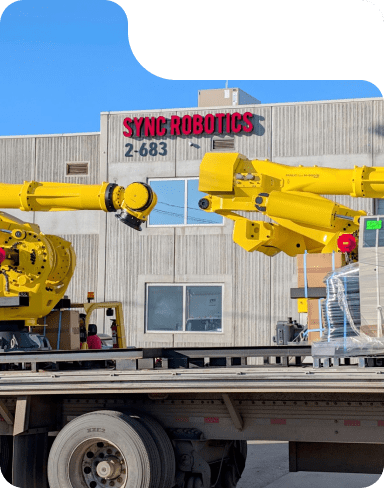
Machine tending is a good example. If machined components feed a weld cell, part presentation from the CNC area affects throughput immediately. A shop that already uses CNC automation often has an easier path into robotic welding because it understands repeatability, guarding, sensors, and standardized setups. The culture is already accustomed to programming, fixture control, and data-driven troubleshooting.
There is also a practical overlap between welding cells and other automation assets. Positioners, conveyors, part-marking systems, inspection devices, and pallet handling often share design principles with machine tending cells. Teams that have experience with HMI programming can make robotic welding systems much easier to run because the interface becomes intuitive instead of cryptic. That is not a small detail. If operators struggle to recover from a minor fault or switch part numbers confidently, uptime suffers even when the robot path itself is excellent.
In some facilities, robotic welding becomes a gateway to broader CNC automation and material flow improvements. Once managers see what happens when one variable process becomes stable, they begin to apply the same thinking elsewhere. The lesson is not that every operation needs a robot. It is that repeatability has compounding value.
What changes during implementation
The first months after installing a robotic welding cell are rarely effortless. Even well-planned projects go through a settling period.
Programs are refined. Fixtures get adjusted. Weld sequences are reworked to reduce distortion. Operators learn the rhythms of loading and fault recovery. Maintenance learns which spare parts need to be stocked and which alarms actually matter. During that period, expectations need to be grounded. If leadership expects instant perfection, the project can be judged unfairly.
The smoother projects tend to share a few habits:
- They qualify the parts and fixtures before blaming the robot.
- They involve production, maintenance, and welding expertise early.
- They simplify operator interaction through clear HMI programming.
- They plan consumables, spare parts, and preventive maintenance from day one.
- They measure rework, uptime, and throughput before and after launch.
Those points sound basic, but they separate cells that become dependable production assets from cells that spend too much time waiting for attention.
One practical detail that deserves emphasis is operator training. Not everyone on the floor needs to become a robot programmer, but the people running the cell need confidence in normal operation. They should understand part loading requirements, basic quality checks, torch inspection, routine cleaning, and what common alarms actually mean. When that knowledge is missing, trivial issues escalate and small stoppages stretch into long ones.
Cost, return, and the trade-offs worth acknowledging
Robotic welding can produce impressive returns, but the business case should never be oversimplified. The purchase price of the robot is only part of the investment. Tooling, fixturing, guarding, extraction, integration, programming, and training all count. So does the effort needed to prepare parts and workflows for automation.
Return usually comes from a blend of factors rather than one dramatic number. Labor redeployment matters. Reduced rework matters. Higher throughput matters. Better schedule reliability matters. In many facilities, the hidden cost savings are what make the investment compelling. Less grinding, fewer missed shipments, lower consumable waste, and fewer quality disputes can add up quickly.
Still, there are trade-offs. Robotic welding is less forgiving of upstream variation. It requires more formal maintenance. Changeovers must be engineered rather than improvised. For some low-volume or highly customized work, manual welding remains the smarter choice. The strongest manufacturers understand that both can coexist. They automate the repetitive, stable work and preserve manual expertise for the jobs where human adaptability still wins.
That balanced approach usually delivers the best long-term result. It keeps skilled welders engaged in higher-value tasks while the robot handles the repetition it is built for.
What better welding looks like on the floor
When robotic welding is working well, the improvement is not limited to the cell itself. The whole area around it starts to feel more orderly.
Parts arrive in a consistent orientation. Fixtures are maintained instead of patched. Operators know what good loading looks like. Inspectors spend less time sorting borderline parts. Schedules become less dependent on one or two highly skilled individuals being present every day. Managers stop firefighting the same weld-related issues. There is a visible reduction in noise, not just sound on the floor, but process noise, the constant stream of variation, exceptions, and rework that drains capacity.
Customers usually experience the result long before they know why it happened. Assemblies fit better. Cosmetic quality improves. Deliveries become more predictable. For suppliers trying to grow with demanding OEMs, that stability can be just as important as a lower unit cost.
Robotic welding earns its value by making performance repeatable. Quality improves because the process is controlled. Speed improves because motion and handling are organized. Consistency improves because the result no longer swings with fatigue, staffing, or shift-to-shift technique. When the cell is supported by sound fixturing, practical end of arm tooling, sensible HMI programming, and disciplined process control, it becomes more than a labor-saving device. It becomes a production standard.
That is the real promise of robotic welding, not replacing craftsmanship, but capturing it in a form that can run every day, at scale, with fewer surprises.
Sync Robotics Inc. — Business Info (NAP)
Name: Sync Robotics Inc.Address: 2-683 Dease Rd, Kelowna, BC V1X 4A4
Phone: +1-250-753-7161
Website: https://www.syncrobotics.ca/
Email: [email protected]
Sales Email: [email protected]
Hours:
Monday: 8:00 AM – 4:30 PM
Tuesday: 8:00 AM – 4:30 PM
Wednesday: 8:00 AM – 4:30 PM
Thursday: 8:00 AM – 4:30 PM
Friday: 8:00 AM – 4:30 PM
Saturday: Closed
Sunday: Closed
Service Area: Kelowna, British Columbia and across Canada
Open-location code (Plus Code): VHWR+PQ Kelowna, British Columbia
Map/listing URL: https://maps.app.goo.gl/xwtV2wEu8ZuKH3se8
Embed iframe:
Socials (canonical https URLs):
LinkedIn: https://www.linkedin.com/company/syncrobotics/
Instagram: https://www.instagram.com/syncrobotics/
Facebook: https://www.facebook.com/syncrobotics/
https://www.syncrobotics.ca/
Sync Robotics Inc. is an industrial robot and controls integration company based in Kelowna, British Columbia.
The company designs and deploys automation solutions for manufacturing operations across Canada.
Services include industrial robotics integration, controls integration, automation system design, deployment support, and related manufacturing automation solutions.
Sync Robotics Inc. is located at 2-683 Dease Rd, Kelowna, BC V1X 4A4.
To contact Sync Robotics Inc., call +1-250-753-7161 or email [email protected].
For sales inquiries, email [email protected].
Hours listed are Monday to Friday 8:00 AM–4:30 PM, with Saturday and Sunday closed.
For directions and listing details, use the map listing: https://maps.app.goo.gl/xwtV2wEu8ZuKH3se8
Popular Questions About Sync Robotics Inc.
What does Sync Robotics Inc. do?Sync Robotics Inc. designs and deploys industrial robot and controls integration solutions for manufacturing operations.
Where is Sync Robotics Inc. located?
Sync Robotics Inc. is located at 2-683 Dease Rd, Kelowna, BC V1X 4A4.
Does Sync Robotics Inc. serve clients outside Kelowna?
Yes—Sync Robotics Inc. is based in Kelowna, British Columbia and serves clients across Canada.
What are Sync Robotics Inc.’s hours?
Monday–Friday: 8:00 AM–4:30 PM; Saturday and Sunday closed.
How can I contact Sync Robotics Inc.?
Phone: +1-250-753-7161
General Email: [email protected]
Sales Email: [email protected]
Website: https://www.syncrobotics.ca/
Map: https://maps.app.goo.gl/xwtV2wEu8ZuKH3se8
LinkedIn: https://www.linkedin.com/company/syncrobotics/
Instagram: https://www.instagram.com/syncrobotics/
Facebook: https://www.facebook.com/syncrobotics/
Landmarks Near Kelowna, BC
1) Kelowna International Airport2) UBC Okanagan
3) Rutland
4) Orchard Park Shopping Centre
5) Mission Creek Regional Park
6) Downtown Kelowna
7) Waterfront Park